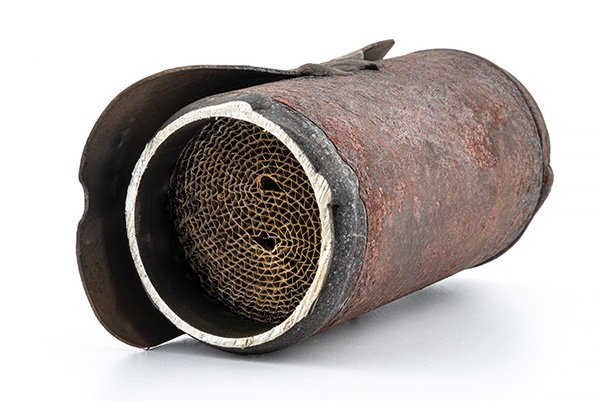
A restricted catalytic converter does not always make the car feel terrible right away. You may notice that it still starts fine, idles reasonably well, and handles light driving without much trouble. Then you ask for more power, and the engine suddenly feels like it is working against something.
That change under load is an important clue. The converter sits in the exhaust stream, so when its internal passages begin to plug or collapse, exhaust gases have a harder time leaving the engine. The restriction can build gradually enough that the driver gets used to the loss of performance.
Power Drops When You Accelerate Hard
One of the more common complaints we hear is that the car feels acceptable around town but weak when merging, climbing a hill, or accelerating at higher RPM. The engine sounds like it is trying, yet the vehicle does not pick up speed the way it should.
That happens because an engine needs to breathe in and breathe out. If exhaust cannot leave quickly enough, pressure builds upstream of the restriction and limits how efficiently the cylinders can clear themselves. Fuel delivery problems, ignition trouble, and transmission issues can feel similar, so the symptom alone does not prove the converter is plugged.
The Engine May Struggle More as RPM Rises
A partially restricted converter can flow enough exhaust at idle or during light cruising. Once engine speed increases, exhaust volume rises quickly, and the restriction becomes much more noticeable.
We sometimes reproduce the problem on a road test by watching how the vehicle responds under steady load. A car that pulls reasonably well at first and then seems to run out of breath as RPM climbs gives us a useful direction. If easing off the accelerator makes the engine feel better again, exhaust restriction is one possibility worth testing.
Excessive Heat Can Point Toward a Converter Problem
Catalytic converters normally run hot, so heat by itself is not unusual. The concern is excessive temperature caused by a damaged converter or by unburned fuel entering the exhaust. A severe misfire or rich-running engine can make the converter overheat enough to damage or melt the internal catalyst.
You might notice a strong hot smell from under the vehicle or, in extreme cases, visible heat around the converter after driving. We also look for signs of discoloration, damaged heat shields, and temperature differences across the exhaust. A converter that overheated once may have internal damage even after the original engine problem has been repaired.
Rattling Can Mean the Internal Material Has Broken
Inside the converter is a ceramic or metallic structure coated with catalyst material. If that structure cracks or breaks apart, pieces can move around inside the housing. The driver may hear a metallic rattle underneath the car, especially during startup, when revving the engine, or while going over bumps.
Broken material does not always stay loose. Pieces can shift and partially block the outlet, creating a restriction that changes from one drive to the next. One inspection can sound normal, then the restriction becomes obvious after the internal material moves again. That is one reason a road test and hands-on checks are useful together.
A Check Engine Light Does Not Automatically Mean the Converter Is Restricted
A catalytic converter efficiency code, such as a P0420 or P0430, tells us the computer sees converter performance outside the expected range. It does not mean the converter is physically plugged.
An oxygen sensor problem, exhaust leak, misfire, fuel mixture issue, oil consumption, or damaged converter can all affect the readings used to set those codes. A restricted converter can also exist without an efficiency code. At our shop, we look at scan data and how the engine behaves instead of replacing the converter just because its name appears in a trouble code.
How We Check for Exhaust Restriction
There are several ways to confirm whether exhaust flow is being blocked. The test we choose depends on the vehicle and the symptoms. We may compare engine vacuum at different RPM, measure exhaust backpressure, review fuel trim and oxygen sensor data, or check temperatures around the converter.
A proper inspection also looks for the cause of the converter damage. Misfires, leaking injectors, excessive oil burning, coolant entering the cylinders, and rich fuel mixtures can ruin a replacement converter if they are left unresolved. Regular maintenance helps catch some of these engine problems before they put unnecessary heat and contamination into the exhaust.
Get Catalytic Converter Diagnostics In California, With DRIVE AutoCare
If your vehicle feels weak under acceleration, struggles at higher RPM, has unusual exhaust heat, or has developed a catalytic converter code, DRIVE AutoCare can test the exhaust system at either of our two Solana Beach, CA, locations and find out whether a restriction is actually present.
Schedule a visit before replacing expensive exhaust parts based only on a warning light or a loss of power.