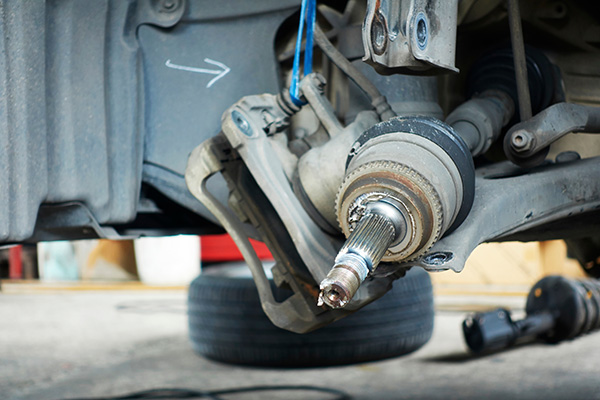
A bad CV axle does not always announce itself with one huge failure. More often, it starts with a clicking sound in a parking lot, a shake during acceleration, or grease splattered where it should not be.
That little clue is easy to miss.
CV axles and CV joints work every time the car moves, especially when you turn and accelerate at the same time. Once they start wearing, the symptoms usually follow a pattern. Catching that pattern early can help prevent a small axle concern from turning into a bigger drivability problem.
What The CV Axle And CV Joint Do
The CV axle transfers power from the transmission or differential to the wheels. The CV joints at each end allow that axle to keep spinning while the suspension moves and the wheels turn.
That flexibility is the important part. Without the CV joints, the axle would bind every time you turned into a driveway or drove over a dip in the road.
Inside each joint are metal parts packed with heavy grease. A rubber boot seals that grease in and keeps dirt, water, and road grit out. When the boot tears or the joint wears, the axle begins to lose the protection it needs.
Clicking During Turns Is A Classic Sign
One of the most common signs of a bad outer CV joint is a clicking or popping sound during tight turns. Drivers often hear it while pulling into a parking space, making a U-turn, or backing out of a driveway with the wheel turned.
The sound may start quietly. Then it becomes more consistent as the joint wears. It usually gets louder when you accelerate through the turn because the joint is under more load.
A clicking CV joint should not be ignored for weeks. The joint is already showing wear, and the noise usually means the smooth movement inside the joint has started to break down.
Grease Near The Wheel Is A Big Warning
A torn CV boot may show up before the axle makes any noise. Look for dark, sticky grease on the inside of the wheel, lower control arm, strut, or nearby suspension parts. It may look like black splatter in a circular pattern.
That grease belongs inside the boot. Once it gets thrown out, dirt and moisture can get in. The joint may still work for a while, but the damage process has started.
During regular maintenance, this is one of the easiest things to catch during an inspection. If the boot is torn but the joint is still quiet and clean inside, there may be more repair options. If the joint has been open and contaminated for too long, axle replacement is usually the better path.
Vibration While Accelerating Can Point To Inner Joint Wear
Not every CV problem clicks during turns. Inner CV joint wear often feels more like a vibration or shudder during acceleration. The car may feel fine while coasting, but it may shake when you press the gas.
That difference matters. Tire balance problems usually occur at higher vehicle speeds. CV axle vibration often follows engine load. If the shake gets worse while accelerating and eases when you lift off the pedal, the axle deserves a closer look.
This symptom can overlap with engine mounts, tires, wheel bearings, or driveline problems, so the source needs to be confirmed before replacing parts.
Clunking Can Mean The Wear Is Getting Worse
A clunk when shifting from reverse to drive, taking off from a stop, or accelerating after coasting can indicate extra movement at the axle or joint. It may also involve worn mounts, suspension parts, or drivetrain movement.
The important thing is that clunking usually means something has too much play. With CV joints, play can continue to worsen as the joint wears.
Our technicians look at the axle, boots, mounts, wheel bearings, suspension parts, and related hardware together. A clunk can travel through the vehicle, so the loudest spot from the driver’s seat is not always the failed part.
Can You Keep Driving With A Bad CV Axle?
A small torn boot or faint clicking sound does not always mean the car is about to stop immediately. Still, driving on a failing CV joint is a risk that grows with time. The joint can get louder, vibrate more, or eventually fail enough that power no longer reaches the wheel correctly.
Avoid hard acceleration, sharp turns under throttle, and rough driving if you suspect an axle problem. The more stress you put on the joint, the faster the wear can progress.
The safer plan is to have it checked early. Axle problems are usually easier to handle before the boot has been torn for months or the joint is making a loud noise on every turn.
Get CV Axle And CV Joint Service In Solana Beach, CA, With DRIVE AutoCare
If your car is clicking during turns, vibrating during acceleration, clunking, or showing grease near a wheel, DRIVE AutoCare in Solana Beach, CA, can check the CV axles, CV joints, boots, and related suspension parts at either of our two local locations.
Schedule a visit and find out whether the axle can be serviced now before the joint wear gets worse.